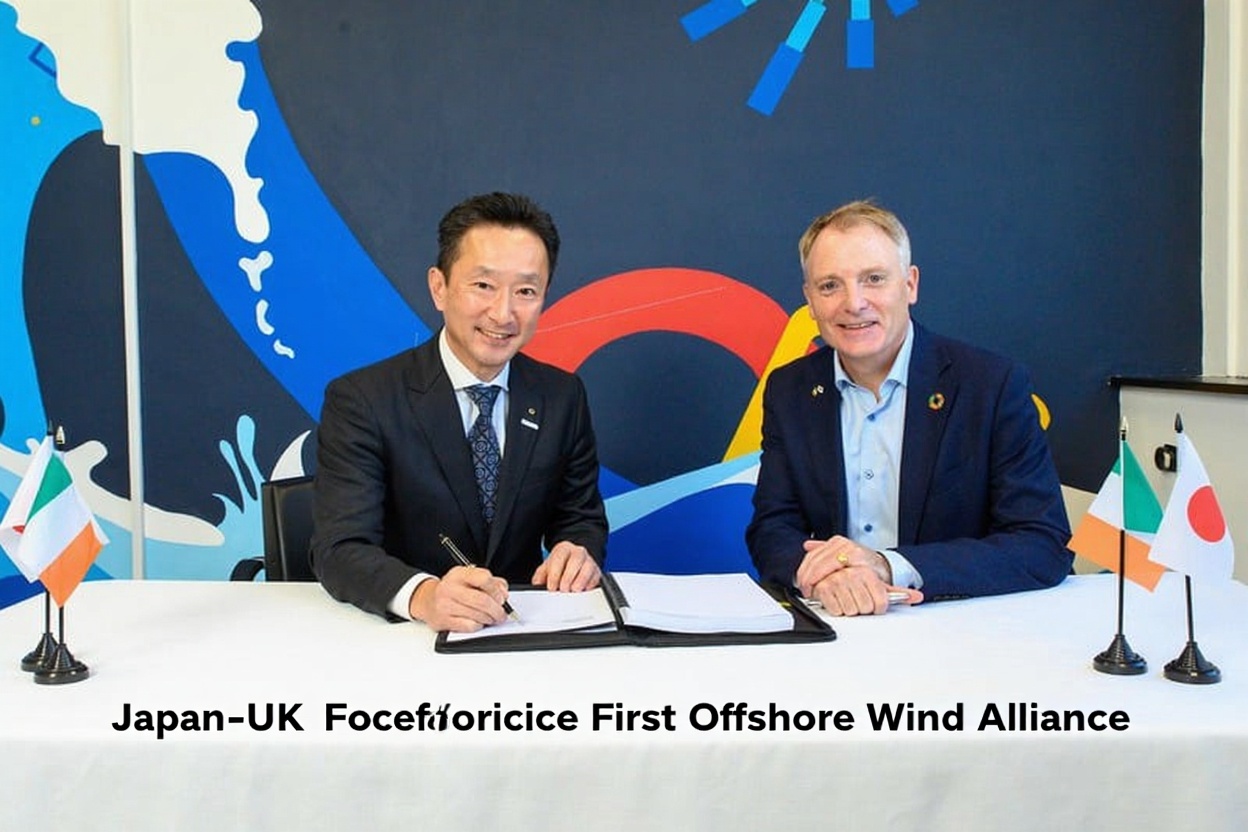
The Japan-UK First Offshore Wind alliance marks an important step in international renewable energy cooperation. This partnership brings together Simply Blue Group, a top European offshore wind developer based in Cork, Ireland, and Japan’s Kansai Electric Power Company (KEPCO), which serves over 13 million customers in the Kansai region. “The support from KEPCO provides the strength and resources needed to scale our operations and improve our offshore wind projects,” said Hugh Kelly, co-founder and CEO of Simply Blue Group.
By merging Japan’s technical skills with Simply Blue’s experience in floating offshore wind projects, the alliance speeds up renewable energy growth in several markets, including Ireland, the UK, Spain, and Canada. KEPCO’s investment shows rising Japanese interest in European offshore wind as the world works toward net-zero emissions.
A Bold Step for Renewable Energy Cooperation
This offshore wind partnership is more than a financial investment. It marks a new era of international teamwork in clean energy. Toru Kuwahara, KEPCO’s executive vice president and general manager of the Global EX Division, described the alliance as a move towards improving offshore wind skills and helping create a carbon-neutral society.
KEPCO’s long-term vision, shared through its Zero Carbon Vision 2050, aims for 5 million kW of new domestic renewable capacity by 2040, with a total of 9 million kW. By investing in Simply Blue, KEPCO gains access to offshore wind development knowledge, including floating and fixed-bottom technologies, environmental impact planning, and large-scale project execution.
Simply Blue Group, founded in 2011, expects that the influx of capital and Japanese technical skills will speed up project delivery across Europe and North America. With offices in Cork, Dublin, Belfast, Newquay, Pembrokeshire, Edinburgh, Bilbao, and Nova Scotia, Simply Blue focuses on local economic benefits and environmental harmony in every project.
Why Japan Sees Offshore Wind as a Strategic Priority
Japan’s energy landscape is changing quickly. With limited domestic fossil fuel resources and ambitious carbon reduction goals, the nation is focusing on offshore wind as a key renewable energy source. Deep coastal waters make floating offshore wind projects especially important, opening up large areas for sustainable power generation in places like Hokkaido, Tohoku, and Kyushu.
By working with the UK’s Simply Blue Group, Japan gains from established European knowledge in large-scale offshore wind development. At the same time, Japan offers its strengths in grid management, engineering, and sustainable energy integration. This Japan-UK First Offshore Wind Partnership shows how international cooperation can speed up the shift to cleaner and more resilient energy systems.
Simply Blue Group: Promoting Innovation Offshore
A major global player in the rapidly expanding offshore renewable energy market is Simply Blue Group. It has more than 12 GW of projects in its portfolio, which includes both fixed-bottom and floating offshore wind developments. The company’s partnership with KEPCO furthers its objective of promoting the blue economy and providing real advantages to nearby communities.
As Taoiseach Micheál Martin noted,
“Simply Blue has been a major player in the fast-growing offshore renewable energy sector. This collaboration with KEPCO will improve its capacity. Together, they will help drive the transition from fossil fuels to clean energy in Ireland and beyond.”
This partnership speeds up project timelines and boosts knowledge-sharing between Japan and the UK. It shows how strategic alliances can improve renewable energy partnerships worldwide.
A Shared Vision for a Carbon-Neutral Future
The Japan-UK First Offshore Wind alliance highlights a shared commitment to sustainability, energy innovation, and the global effort for net-zero emissions. KEPCO is diversifying beyond traditional power generation by moving into renewables, telecommunications, and real estate. Meanwhile, Simply Blue is using Japanese support to grow its operations effectively.
Together, this partnership acts as a model for international renewable energy cooperation. By joining their technical skills, financial support, and strategic ideas, Japan and the UK show that working together is essential for creating a cleaner, more sustainable energy future.

Ismot Jerin is the founder and Editor-in-Chief of WindNewsToday, an independent publication covering offshore wind, renewable energy policy, and clean power markets with an analytical focus on the United States and global energy transition.