WindNewsToday

Poland’s Baltic Power Offshore Wind Farm Breaks Records

Poland’s Baltic Power Offshore Wind Farm Breaks Records

Poland has reached a major milestone in its offshore wind energy journey with the successful installation of its first offshore substations in the Baltic Sea. The achievement comes from the Baltic Power Offshore Wind Farm, a joint venture between ORLEN Group and Northland Power, marking a historic step for Poland’s renewable energy sector.

Built in Gdańsk and Gdynia, the two four-story offshore substations will collect electricity from 76 high-capacity wind turbines before transmitting it to shore. Once operational, the infrastructure will play a central role in strengthening Poland’s offshore wind leadership, boosting sustainability in the Baltic Sea, and accelerating the country’s clean energy transition.

Baltic Power Offshore Wind Farm: A new era of Poland Offshore Wind

Poland’s offshore wind sector has entered a decisive new phase with the successful installation of its first offshore substations in the Baltic Sea. The milestone was achieved by the Baltic Power Offshore Wind Farm, a joint venture between ORLEN Group and Northland Power, marking a historic breakthrough for Poland’s renewable energy industry.

The installation strengthens Poland’s growing role in Europe’s clean energy transition and establishes the critical infrastructure needed to connect offshore wind generation with the national power grid.

This project highlights how Poland’s offshore wind energy is rapidly moving from planning to large-scale execution in the Baltic Sea.

Offshore Substations: The Backbone of Baltic Power

The two four-story offshore substations—massive steel structures weighing up to 2,500 tonnes each—form the electrical heart of the Baltic Power project. Located around 20 kilometers offshore near Choczewo, the substations create the vital link between sea-based wind turbines and Poland’s onshore electricity network.

With a planned capacity of 1.2 gigawatts (GW), Baltic Power is expected to generate approximately 4 terawatt-hours (TWh) of renewable electricity annually—enough to supply more than 1.5 million homes and cover nearly 3% of Poland’s current electricity demand.

According to the Energy Information Administration (EIA), wind power continues to increase its share of electricity generation across Europe and globally.

Engineering Excellence in the Baltic Sea

The OSS West and OSS East substations collect electricity from 76 Vestas 15 MW offshore wind turbines through an extensive network of inter-array cables. Power is then stepped up to 230 kV and transmitted to the onshore substation in Choczewo via four offshore export cables, ensuring efficient integration into Poland’s grid.

Each unmanned offshore platform is equipped with:

  • Two main transformers
  • Gas-insulated switchgear at 230 kV and 66 kV
  • Diesel generators and auxiliary systems
  • Automated monitoring, control, and safety technologies

This design allows fully remote operation while maintaining high reliability in challenging marine conditions.

Strong Polish Industrial Participation

The offshore substations were delivered through a partnership between CS Wind Offshore and Semco Maritime, supported by multiple Polish companies. Substation foundations were built by Grupa Przemysłowa Baltic at shipyards in Gdynia and Gdańsk, reinforcing local industrial participation.

Following fabrication, the topsides were transported to Denmark for final outfitting before being installed offshore. Notably, both substations were equipped with specialized cranes manufactured by Protea, a Polish engineering firm, highlighting domestic contribution to advanced offshore technology.

Over its 30-year operational lifespan, Baltic Power is expected to achieve a local content share of at least 21%, strengthening Poland’s offshore supply chain and marine engineering expertise.

From Sea to Shore: A Coordinated Offshore Installation

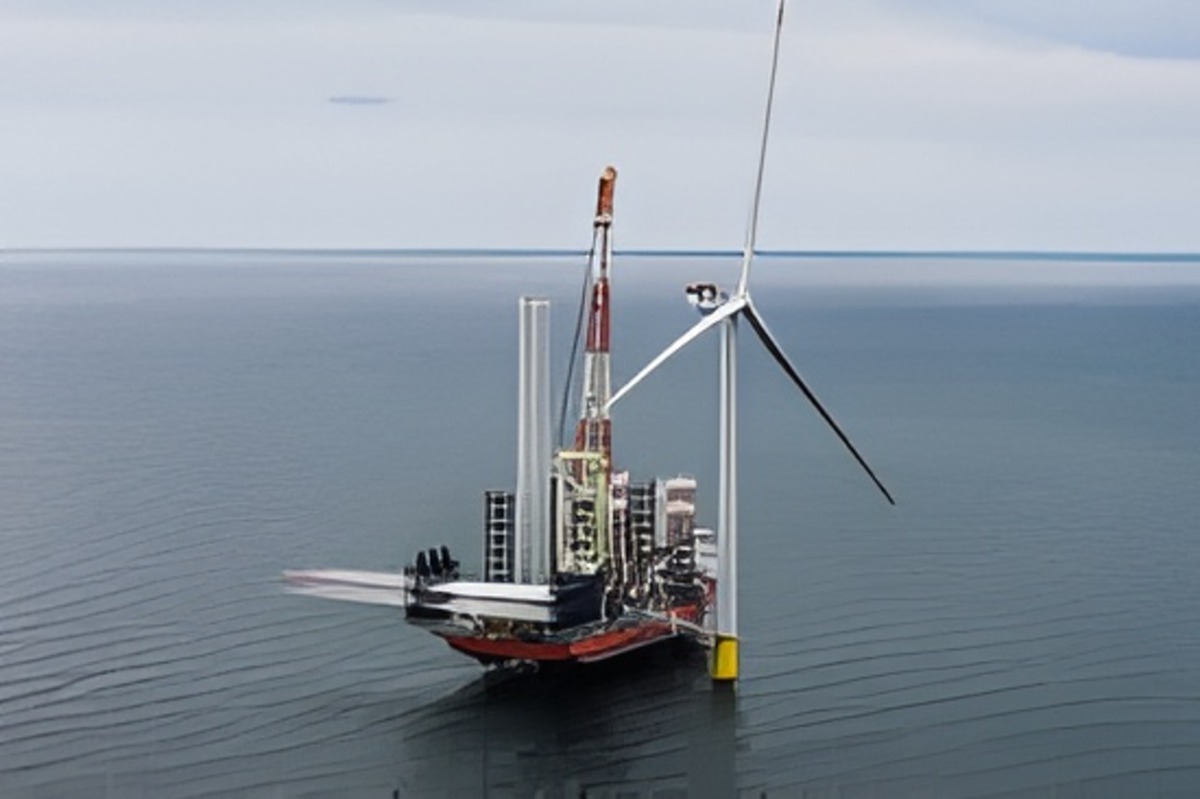
Installing the substations required one of the most complex offshore operations ever conducted in Polish waters. Using floating heavy-lift cranes, tugboats, and crew transfer vessels, teams precisely positioned the steel structures and transition pieces onto their monopile foundations.

More than 20 specialized vessels supported the installation campaign, coordinated from Baltic Power’s newly operational offshore base in Łeba, which has been active since April 2025.

Project Director Jens Poulsen described the phase as “extremely intense,” noting that the next step will involve installing offshore cables to complete the wind farm’s internal electrical network.

Offshore wind leasing and permitting standards referenced in this project align with international frameworks outlined by the Bureau of Ocean Energy Management (BOEM).

What Baltic Power Means for Poland’s Energy Future

Beyond engineering success, the completion of the offshore substations signals Poland’s formal entry into the European offshore wind market. When fully operational in 2026, Baltic Power will become Poland’s first offshore wind farm, delivering reliable, clean electricity while reducing carbon emissions.

The project is also expected to drive economic growth through:

  • Shipbuilding and port investments
  • Engineering and logistics jobs
  • Long-term grid modernization

By combining international offshore wind expertise with strong local industry participation, Baltic Power is setting a benchmark for future developments.

As construction progresses, one key question remains:
Will Baltic Power become the blueprint for Poland’s next wave of offshore wind projects?

FAQ

Q: What milestone has Poland achieved in offshore wind energy?
A: Poland has installed its first offshore substations in the Baltic Sea, marking a major step forward for the country’s offshore wind and renewable energy sector.

Q: Who is developing the Baltic Power Offshore Wind Farm?
A: The project is a joint venture between ORLEN Group and Northland Power, combining domestic and international offshore wind expertise.

Q: What role do the offshore substations play?
A: The substations collect electricity from 76 offshore wind turbines and transmit it to shore for distribution through Poland’s power grid.

Q: Why is this project important for the Baltic Sea region?
A: The project supports cleaner energy production, strengthens Baltic Sea sustainability, and reduces reliance on fossil fuel-based electricity.

Q: How does this project support Poland’s energy transition?
A: It accelerates Poland’s shift toward renewable energy, improves energy security, and positions the country as an emerging offshore wind leader in Europe.

China Breaks Another Record With 46 MW of Wind Power Generation

China renewable energy record 2025

China renewable energy news is great, with wind power boom in January-May enough to power entire countries like Indonesia or Turkey

BEIJING—June 2025

A charming example is set by china renewable energy record. China added 46 gigawatts (GW) of wind power and 198 gigawatts of solar power between January and May 2025, breaking China’s previous records and cementing its leadership in the global clean energy race. The Guardian says the added capacity of wind and solar power during the five-month period in 2025 is enough to produce as much electricity as Indonesia or Turkey, according to Lori Mylivirta’s analysis, a senior fellow at the Asia Society Policy Institute.

In May alone, China solar power grew by 93 gigawatts of installation, the equivalent of about 100 China solar panels installed per second, and wind power capacity added 26 gigawatts, the size of about 5,300 turbines. These installations could power countries like Poland, Sweden, and the United Arab Emirates, depending on operating conditions and efficiency.

China renewable energy record amid global climate tensions

The latest development comes amid ongoing informal climate talks between Chinese officials and former US negotiators in Beijing. Diplomatic relations over climate action have been strained since former President Donald Trump withdrew the United States from the Paris climate accord, accusing China of rampant pollution while protecting domestic industry.

Despite being the world’s largest greenhouse gas emitter, China is also by far the largest producer, installer, and exporter of clean energy technology. China suppresses 1000 GW of solar capacity, half of the total global production, according to government data and third-party trackers.

China green energy leadership happened because of Xi Jinping’s climate strategy. Chinese President Xi Jinping’s renewable energy speech has increasingly tied the country’s climate goals to national industrial policy, framing clean energy expansion as essential to rejuvenating the economy.

China’s role in the global climate talks now is not just about how much wind power China adds in 2025, but also about how it is winning the global clean energy race. “In the past five years, China has built the world’s largest and most complete new energy industrial chain,” Xi said at a conference in April.

This development has been accompanied by an explosive growth in supply chains and exports. But it has also put the financial squeeze on the whole of China’s solar industry. According to Bloomberg, the five largest Chinese solar companies reported a combined loss of more than 8 billion yuan in Q1 of 2025.

Speaking at a recent industry conference, Yang Liyou, general manager of Jinneng Technology, said the existing pricing and production model was a “death cycle,” suggesting hyper-competition and wafer-thin margins could endanger the stability of China’s place as the world’s clean energy manufacturing kingpin.

World Impact and Climate Implications

China Wind Power 2025

China’s breathtaking build-out of wind and solar installations isn’t just actively reshaping its own energy landscape—it’s sending ripples out across global energy markets, upending international geopolitical strategies and, with it, the future of the clean energy transition.

Economically, sprawling production in China has pushed global prices for solar panels and wind components to historic lows. China solar and wind growth is good for developing countries with demand for affordable, clean energy, but it is also putting pressure on Western manufacturers, some of whom are pushing for trade barriers and subsidies to shield their domestic clean energy industries.

Politically, these numbers give China the ability to leverage climate diplomacy, particularly at a time when the United States and the E.U. are pressing for steeper emissions cuts even as they struggle with their own internal policy divisions. Now that China’s momentum in clean energy has become tightly linked to its economic strategy, the country will have an upper hand in future climate talks — especially since some Western powers are rethinking their dependence on Chinese-made technologies.

China clean energy expansion surge also speaks to a bigger pattern: the global center of gravity for energy innovation is shifting east. If the trajectory holds, China will be not only the largest emitter or the largest builder of clean energy, but it will also become the yardstick by which we measure whether, in the next generation of energy infrastructure, we will have a livable planet or not.

As China continues to pull ahead with the deployment of clean power, the geopolitics and economics of energy transition are changing. The sheer magnitude of the country’s manufacturing and installation has driven down worldwide prices but has also spawned concerns about sustainability, labor practices, and market fairness.

Meanwhile, nations like the U.S. and those in the EU are re-evaluating trade and subsidy strategies to safeguard domestic clean energy industries while attempting to achieve net zero goals.

As new solar and wind capacity is added at record-breaking rates—and political rhetoric is tightly intertwined with industrial strategy—China is, for once, not just competing in the race, Ms. Hsu said. It’s setting the pace.

China solar and wind power growth: Jan–May 2025

🌬️ 46 GW of wind power added

☀️ 198 gigawatts of solar power added

May only: 93 GW solar, 26 GW wind

🏆 Total installed solar: 1,000+ GW

📈 Enough new capacity to power Poland, Sweden, Indonesia, Turkey

So that China renewable energy record in 2025 represents a turning point for how the world uses energy. And with 46 GW of wind and 198 GW of solar deployed in only the first five months of the year, the country isn’t just outpacing its own climate targets, or lucrative wind and solar installation in china but redefining the global clean energy market.

Challenges endure—from economic hardship facing domestic producers to mounting geopolitical suspicion—but China’s sheer scale, speed, and strategic linking of clean energy with economic policy have made it an unparalleled force in the field. As the world once again contemplates the urgent need for climate action and for secure energy, China’s market moves are making clear that the race to dominate renewable energy is no longer some nod to a green future—it’s on.

Greenvolt Group Lights Up 33.2 MW Wind Portfolio to Enea Nowa Energia in Poland

Greenvolt Group Lights Up 33.2 MW Wind Portfolio to Enea Nowa Energia in Poland

Greenvolt Group, through its subsidiary Greenvolt Power, has finalized an agreement to sell its 33.2 MW wind power portfolio in Poland to Nova Energia. The €83.3 million transaction includes four wind farms in various stages of development and a total of 16 turbines, each with a capacity of between 2 MW and 2.2 MW.

The move follows two recent utility-scale transactions by Greenvolt Group worth an equivalent of €250 million, which sees Greenvolt Power playing a key role in growing and monetizing clean energy infrastructure in utility-scale renewable projects across Europe.

Wind Project Glimpse

Greenvolt Group is the seller through Greenvolt Power

Enea Nowa Energia subsidiary of Enea Group is the buyer

Investment Volume is €83.3 million

Total Capacity if power is 33.2 MW

Operatinng Wind Farms: 4 projects

Total Turbines USed: 16 Vestas V110 (2–2.2 MW each)

  • Operational Status: Skibno Wind Farm – 10 MW (Operational)
  • Zaklików – 10 MW (Under Construction)
  • Nowe Miasto Lubawskie – 6.6 MW (Under Cons truction)
  • Jabłonowo Pomorskie – 6.6 MW (Under Construction)

Contraction Timeline: Remaining projects to be operational by 2026

Strategic Objective:

  • Greenvolt: Asset rotation model (selling 70–80% of projects)
  • Enea: Expanding renewable portfolio under 2035 development strategy

Greenvolt’s Portfolio in Poland:

  • 731 MW Wind
  • 1,878 MW Solar PV
  • 2,712 MW Battery Storage

Wind Farm Portfolio Objectives

The wind farm portfolio includes:

Skiebno Wind Farm: a 10 MW wind farm located in northwestern Poland that is already operational.

Zakliko Wind Farm: located in the south-east of the Subcarpathian region, with an installed capacity of 10 MW.

Nowa Miasto Lubowski Wind Farm: Located in northern Poland with a capacity of 6.6 MW.

Jablonowo Pomorskie Wind Farm: Located in the north with a capacity of 6.6 MW.

Three non-operational sites are currently under construction, equipped with Vestas V-110 turbines. They are expected to start commercial operations around 2026.

In the words of Enia Nowa Energia

Enia Nowa, one of the largest electricity suppliers in Poland, continues its commitment to the development of renewable energy. Enia’s Vice President for Commercial Affairs, Bartosz Krysta, emphasized the importance of green energy:

Bartosz Kryst. Image: Linkdln

Company’s’ CEO Arkadiusz Arustowicz cited:

Greenvolt Group’s vision for 2035

This acquisition is in line with Enia Group’s development strategy 2035, as it foresees investments of £107.5 billion (€25.3 billion) – most of which will be directed towards renewable energy, energy storage and the modernisation of distribution infrastructure.

With each transaction, Enia and Greenvolt continue to push the boundaries of Europe’s energy transition, making Poland a central player in the continent’s green future. For this reason,

Bartosz Krysta, Vice-President of Enia’s Management Board, stressed that this acquisition is another important step in Enia’s transition to sustainable energy, fully in line with national environmental and energy security goals.

João Manso Neto

In addition, João Manso Neto, CEO of the Group, highlighted that this deal demonstrates company’s ability to effectively deliver and monetize large-scale renewable projects, supporting its business model of 70-80% asset turnover at various stages of preparation.

Previously, this company also sold the Pelplin wind farm and the Sompolno hybrid project – further strengthening its capital base and reaffirming its position as a top-tier renewable developer in Europe.

With this deal, Greenvolt is strengthening its 13.2 GW utility-scale portfolio, operating 18 countries, including 731 MW of wind, 1,878 MW of solar PV and 2,712 MW of battery storage in Poland alone.

Poland’s renewable energy Target Matters

The second largest Wind farm Developed by the a Woman Enthusiast, Image: Notes From Poland

Country’s energy sector is still heavily dependent on fossil fuels, particularly coal. While it has made progress in wind and solar power, coal remains the main source of electricity generation. In 2024, 57% of the country’s electricity generation will come from coal, and in 2023, 63%.

As part of the National Energy and Climate Plan, it has set a target of 56% of the electricity mix and announced an investment of PLN 792 billion (about $205 billion) to achieve the target. But the 2030 renewable energy target is important because it faces challenges in diversifying its coal fuel sources. European this country is said to a home of Europe’s largest coal mines, the Mainz.

Wind energy started supply electricity since 2019. While it has set a target, reaching it is not easy, with the Greenvolt group project accelerating discussions on four wind projects.

Last words:

The €83.3 million transaction solidifies Greenvolt’s role in Poland’s renewable energy landscape and supports Enia Group’s strategic move towards sustainability, contributing to a green, resilient European energy goals.