
The Race Between Growing Electricity Demand and Grid Capacity
For much of the past 15 years, U.S. electricity consumption changed slowly enough that utilities could plan around a relatively stable demand base. That assumption is weakening.
The U.S. Energy Information Administration’s 2026 Annual Energy Outlook estimates that U.S. electricity consumption increased at an average rate of 2.1% a year over the five years through 2025, after roughly 15 years of nearly flat consumption. EIA projects continued growth through 2050, with annual electricity-consumption growth ranging from 0.9% to 1.6% across its modeled cases. Data-center electricity use is one of the factors driving the change.
The national number, however, does not tell the whole story.
Some of the fastest-growing loads are highly concentrated. A new data center campus, semiconductor plant, battery factory, or large industrial facility can add hundreds of megawatts in a particular location. That creates a different planning problem from the gradual increase in household and commercial consumption that utilities have historically managed.
The result is a shift in the question facing the U.S. power sector.
It is no longer simply how much electricity America can generate.
It is increasingly whether the country can build generation, transmission, substations, interconnection capacity, storage, and market infrastructure quickly enough—and in the right places—to deliver electricity when customers need it.
The distinction matters because electricity is not useful merely because it exists somewhere on the national system. A region can have substantial generation resources while a particular load center faces transmission constraints, limited interconnection capacity, or insufficient local infrastructure.
That is the emerging race between U.S. electricity demand and grid capacity.
Table of Contents
Why America’s Electricity Demand Is Rising Again
The recent change in electricity demand is not being driven by one technology.
Data centers are one of the most visible contributors, particularly as artificial-intelligence computing increases the amount of electricity required by large computing facilities. But manufacturing investment, transportation electrification, building electrification, and regional economic growth are also changing load forecasts.
The important difference is the size, location, and speed of some of these new loads.
Data centers are changing the shape of demand
Data centers have always consumed electricity, but the scale of today’s facilities is different.
Hyperscale campuses can represent very large continuous loads. AI computing adds another dimension because high-performance computing can require substantial power density and cooling infrastructure. Unlike many traditional commercial loads, these facilities generally require highly reliable electricity around the clock.
EIA’s 2026 outlook projects that electricity consumed by data-center servers could reach between 446 billion and 818 billion kilowatt-hours in 2050, depending on the scenario. The upper figure comes from EIA’s High Electricity Demand case. These are projections rather than guaranteed outcomes, and the range illustrates how sensitive future demand is to assumptions about server power consumption and the growth of data-center capacity.
The geographic concentration is just as important as the national total.
A data center does not draw electricity from an abstract national pool. It needs a physical connection to a local distribution or transmission system, and that connection can require new substations, transformers, transmission upgrades and generation resources.
That is why large-load planning has become an issue for regional grid operators.
PJM’s 2026 forecast, for example, projects summer peak demand in its territory at 222,106 MW in 2036, an increase of 65,733 MW from the starting point of the forecast, and 253,077 MW in 2046. PJM’s forecast also projects winter peak growth at an average of 4.0% annually over the next 10 years.
PJM’s forecast is regional, not a prediction for the entire United States. But it demonstrates why national averages can hide the scale of the problem in particular markets.
Manufacturing is another source of concentrated load
The expansion of semiconductor, battery, and other advanced manufacturing facilities adds another form of electricity demand.
These facilities can require large quantities of electricity at specific locations, often with demanding reliability requirements. Their impact therefore extends beyond annual consumption. Utilities must determine whether local substations, transmission lines and generation resources can support the new load without creating unacceptable reliability problems.
This is one reason electricity planning is increasingly connected to industrial policy and economic development.
For a company considering a major factory, access to electricity is part of the physical infrastructure of the site. The question is no longer simply whether land and labor are available. It can also be whether sufficient power can be delivered within the company’s construction timetable.
Transportation and buildings add a different kind of growth
Electric vehicles, fleet charging, heat pumps and electric heating can increase electricity use without creating a single enormous industrial load.
Their effect can be more dispersed, but timing matters.
EV charging can add demand during particular hours. Electrification of heating can increase winter electricity demand in regions where heating has historically relied more heavily on natural gas or other fuels. Heat waves can produce sharp summer peaks as air-conditioning demand rises.
ISO New England’s 2026 forecast illustrates this regional effect. The ISO expects net electricity use in New England to increase from 116,679 GWh in 2025 to 127,660 GWh in 2035, an average annual increase of about 1.0%. It identifies transportation and heating electrification among the contributors to that growth.
The U.S. therefore does not have one single electricity-demand trend.
It has a collection of regional demand stories driven by different combinations of computing, industry, electrification, population, and economic activity.
The Grid Was Not Built for This Kind of Growth
The challenge becomes clearer when generation is separated from delivery.
The United States has a very large installed generation fleet. But generation capacity and deliverable power are not the same thing.
A power plant may have sufficient capacity, yet transmission constraints can prevent electricity from reaching a particular load center. A new factory may have a signed development agreement, yet its electricity service may depend on a substation upgrade that takes years. A renewable project may have an attractive resource but remain unable to deliver power because the required transmission upgrade has not been completed.
This is the physical side of the electricity-demand problem. Grid infrastructure—including transmission lines, substations and interconnection capacity—is becoming increasingly important as new loads emerge.
The Department of Energy’s 2026 National Transmission Needs Study draft identifies additional transmission infrastructure as necessary to address load growth, new generation and load interconnections, reliability needs and congestion. DOE’s assessment explicitly treats future transmission constraints as part of the national planning problem rather than simply looking backward at historical congestion.
At the same time, the equipment required to expand the grid can itself become a constraint.
DOE reports that distribution-transformer lead times increased from roughly three to six months in 2019 to 12 to 30 months in 2023, with supply-chain pressures continuing to receive federal attention in 2026. DOE has also highlighted longer lead times for larger transformers used at substations and generation facilities.
That creates a difficult sequence:
Demand grows → new power is needed → new generation and transmission are planned → equipment must be manufactured → permits must be obtained → projects must be constructed → customers must finally be connected.
The customer may be ready before the grid is.
The Real Bottleneck May Be Getting Electricity to Where It Is Needed
Transmission is the bridge between generation and load.
But building that bridge can take much longer than announcing a new generation project or signing an industrial development agreement.
DOE says federal permitting for a new electric transmission line takes approximately four years on average, while the broader process of developing and building transmission can take upwards of 10 years. DOE identifies fractured planning processes, financing, and environmental permitting among the factors contributing to long development timelines.
The problem is partly institutional.
Transmission projects can cross multiple states and involve utilities, regional grid operators, state regulators, federal agencies, landowners, and communities. Questions about who benefits from a project can become questions about who should pay for it.
FERC’s Order No. 1920, issued in 2024 and subsequently modified through rehearing orders, requires transmission providers to conduct long-term regional planning and develop methods for allocating the costs of projects identified through that process. The rule establishes a planning horizon of at least 20 years and gives state regulators a larger role in the process.
That matters because transmission cannot be planned efficiently using only today’s electricity map.
A line that looks unnecessary under today’s load can become valuable if a large industrial cluster, data-center region, or new generation corridor develops over the next decade.
The reverse is also possible. A forecasted load may fail to materialize, leaving customers to question why infrastructure was built.
That makes long-term transmission planning a policy question as much as an engineering one.
America’s New Electricity Load Is Not Evenly Distributed
The national electricity system is better understood as a collection of regional systems than as one uniform grid.
PJM provides one of the clearest examples.
Its 2026 forecast projects summer peak demand to grow from the current base to more than 222 GW by 2036 and approximately 253 GW by 2046. Individual zones have substantially different growth rates, reflecting different combinations of data centers, electrification, economic activity, and other factors.
Texas presents another version of the problem.
ERCOT’s 2026 summer outlook forecasts a 92,211 MW summer peak under its weather assumptions, compared with an 83,679 MW peak in 2025. ERCOT also identified approximately 1,725 MW of expected large-load growth between May and September 2026. The forecast reflects both weather and new load, rather than simply measuring long-term annual consumption.
California offers a different example.
CAISO’s planning documents incorporate demand from data centers, transportation and building electrification, manufacturing and other large loads. Its 2026 large-load materials cite a California Energy Commission forecast of data-center load increasing by 1.8 GW by 2030 and 4.9 GW by 2040 within the ISO system.
New England’s growth profile is different again. ISO New England expects electrification of transportation and heating to contribute to rising energy use and peak demand over the coming decade.
These examples reveal why the phrase “U.S. electricity demand growth” needs context.
The demand driver, timing, generation mix, and transmission constraints can be completely different from one region to another.
More Generation Does Not Automatically Solve the Grid Problem
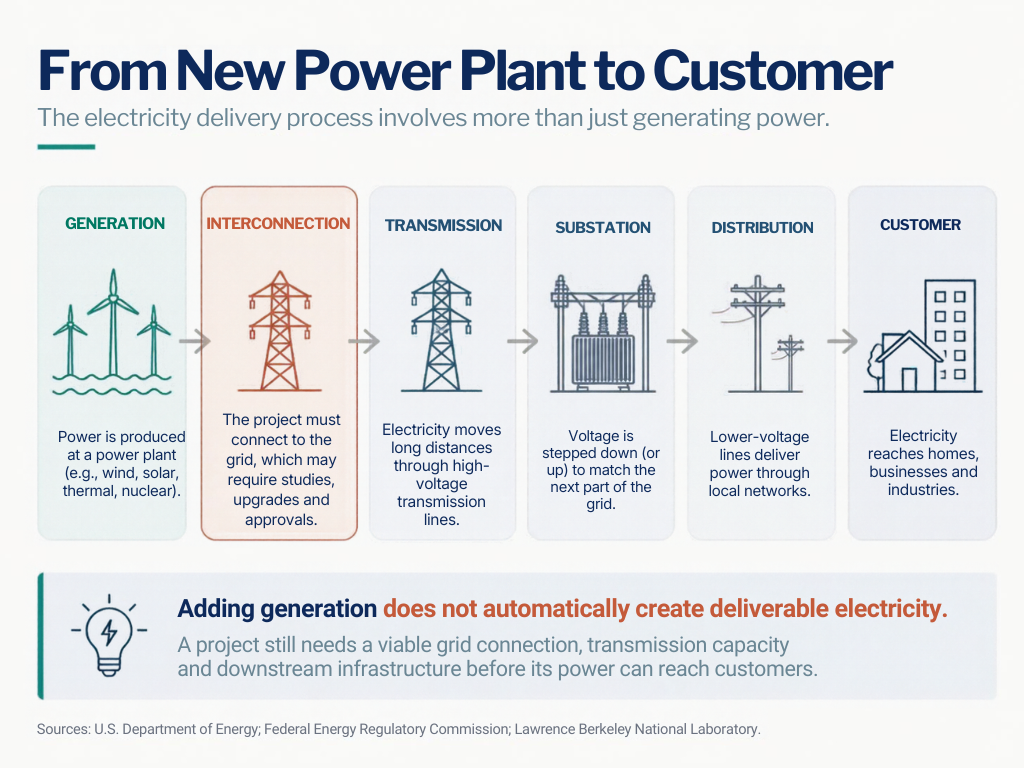
It is tempting to frame rising electricity demand as a simple requirement for more power plants.
That is only part of the equation.
Natural gas plants, nuclear facilities, solar farms, wind projects, batteries, and hydroelectric resources can all contribute to meeting demand. Demand response can reduce the amount of generation required during particular periods. Storage can shift electricity from one period to another.
But none of these resources eliminates the need for a network capable of moving electricity.
Consider a simplified example.
A large solar project may have enough capacity to serve a growing load center. If the transmission corridor between the project and the customers is constrained, however, the additional generation does not automatically translate into additional deliverable power.
The same principle applies to offshore wind.
Generation and grid capacity are related, but they are not interchangeable.
The power system has to work as an integrated machine:
generation → interconnection → transmission → substations → distribution → customer
A weakness at any major step can limit the usefulness of the others.
Offshore Wind Has a Grid Problem Too
Offshore wind illustrates this relationship particularly clearly.
Some of the strongest U.S. offshore wind resources are located offshore from major coastal population centers, while the electricity ultimately has to enter onshore transmission networks and reach customers.
That makes transmission planning part of offshore wind development rather than a separate issue.
A project can have a lease, a development plan and a generation technology. It still needs a physical path into the electricity system.
DOE and the Bureau of Ocean Energy Management have therefore examined strategic offshore-wind transmission planning, including coordinated approaches for connecting future projects to the grid. On the West Coast, a January 2025 federal action plan examined how first-generation offshore-wind projects could connect to the Western grid and how transmission could support longer-term development.
The value of coordinated transmission is potentially broader than any single project.
Instead of developing separate connections for each project without considering the wider system, planners can examine whether shared or strategically located transmission infrastructure could serve multiple projects and improve system flexibility.
That does not make offshore wind automatically economical or guarantee that proposed projects will be built.
It does demonstrate why offshore wind development cannot be separated from the physical grid that has to absorb the electricity.
Why Interconnection Has Become a Major Problem
There is another distinction that is easy to miss:
A proposed project is not the same thing as a connected project.
The U.S. interconnection queue contains projects that have requested permission to connect to the transmission system. Some will be built. Others will be withdrawn, delayed, redesigned, or cancelled.
Lawrence Berkeley National Laboratory’s 2026 Queued Up analysis, covering data through the end of 2025, found approximately 8,200 active projects seeking transmission-grid interconnection, representing about 1,312 GW of generation capacity and 749 GW of storage. LBNL notes that queue data are an indicator of potential future additions, not a forecast that all projects will reach commercial operation.
That distinction is critical.
A project enters the queue because its developer wants to connect it. But the grid may require studies and upgrades before the connection is possible.
The process can involve:
- system-impact studies;
- transmission upgrades;
- network modeling;
- cost allocation;
- engineering work;
- permitting;
- construction.
Historically, high withdrawal rates have meant that the headline size of the queue substantially overstates the generation that will ultimately be built.
The issue therefore is not simply the number of gigawatts waiting.
The issue is whether the interconnection process can distinguish serious projects from speculative ones, identify required upgrades efficiently, and connect viable projects without imposing unreasonable costs or delays on other customers.
That is why changes to interconnection procedures matter almost as much as the size of the queue itself.
Reliability Is Becoming a Different Planning Problem
Reliability planning has never been only about having enough megawatts.
It is about having sufficient resources when and where they are needed.
That becomes more complicated when electricity demand is changing rapidly, generation is increasingly diverse, older plants retire and extreme weather can affect both supply and demand.
NERC’s 2025 Long-Term Reliability Assessment covers 2026–2035 and evaluates projected demand, resources, transmission, and regional reliability conditions. NERC emphasizes that its projections are not predictions; they are based on information submitted by industry participants and represent a planning reference case.
This distinction between forecast and outcome is important.
Reliability planners have to make decisions before they know exactly what future demand will be.
That means planning for uncertainty through:
- reserve margins;
- firm generation;
- flexible resources;
- storage;
- demand response;
- transmission;
- improved forecasting;
- regional coordination.
A battery may provide flexibility but cannot necessarily replace every form of generation. A transmission line can move power between regions but cannot create electricity that does not exist. Demand response can reduce peak requirements but depends on customers being able and willing to change consumption.
Reliability is therefore becoming increasingly about system flexibility, not simply installed capacity.
Can America Build the Grid Fast Enough?
The difficult part of grid expansion is that many of the required technologies already exist.
The constraint is often deployment.
Transmission lines require planning, siting, and permitting. Substations require equipment. Transformers require manufacturing capacity. Utilities need engineers, construction crews, and financing. Regulators need to approve projects and cost recovery. Grid operators need forecasts that are credible enough to justify long-lived infrastructure.
The equipment supply chain adds another layer.
DOE says the nation’s grid-component supply chain faces constraints affecting transformers and other critical equipment. The department reported that demand for distribution transformers had increased substantially and that long lead times were affecting utilities’ ability to expand and maintain infrastructure.
The response does not have to be limited to building entirely new transmission corridors.
Several approaches can expand system capability more efficiently in particular circumstances:
Reconductor existing lines. Replacing conductors can increase the capacity of existing rights-of-way without building an entirely new corridor.
Advanced conductors. New conductor technologies can potentially increase power-transfer capability where technically and economically appropriate.
Grid-enhancing technologies. Dynamic line ratings, power-flow controls and related technologies can improve the use of existing networks.
Storage. Batteries can shift energy and provide grid services, although their capabilities depend on duration, location and operating conditions.
Demand response. Flexible customers can reduce or shift consumption during constrained periods.
Virtual power plants and distributed resources. Aggregated batteries, flexible loads, electric vehicles and other resources can contribute to system flexibility.
Better interconnection processes. Faster and more coordinated studies can reduce unnecessary delays.
None of these solutions is universal.
The important distinction is between technologies that are already commercially deployed at scale, technologies expanding into wider applications, and proposals that remain at an earlier stage.
The grid will need a portfolio of solutions rather than a single technology.
What This Means for America’s Energy Economy
Grid capacity may sound like an engineering problem.
Increasingly, it is an economic-development problem.
A company deciding where to build a data center, semiconductor facility, battery plant, or other large industrial project needs confidence that electricity will be available when the facility is ready.
If the local grid cannot accommodate the load, the project may require new transmission, a new substation, additional generation or a different connection arrangement.
That can affect the timing and cost of investment.
The same principle works in the opposite direction.
Where grid infrastructure is available, additional generation and industrial load can reinforce one another. New transmission can connect generation to markets. New generation can support industrial expansion. Large customers can create demand that improves the economics of infrastructure investment.
This creates a feedback loop between electricity infrastructure and regional economic development.
The question for policymakers and utilities is therefore increasingly practical:
If a company wants to build a major factory or data center, can the electricity system deliver the required power on the timetable the company needs?
That question will increasingly influence where investment occurs.
What a More Reliable, More Flexible Grid Could Unlock
The grid is not simply a constraint.
It is also infrastructure that can expand the choices available to the economy.
A stronger transmission network can connect generation across wider areas and reduce the consequences of localized constraints. Additional capacity can make it easier to integrate new generation resources. Storage and demand response can provide flexibility when supply and demand do not line up.
The benefits extend beyond renewable energy.
A better-connected system can support natural-gas generation, nuclear power, solar, wind, hydroelectric resources and storage according to the needs of each region.
It can also support new industrial loads.
California’s approved 2025–2026 transmission plan, for example, includes projects intended to accommodate forecast load growth while providing access to substantial amounts of new generation and storage. CAISO says the plan responds to demand growth associated with electrification, manufacturing and large loads, including data centers.
That is the more useful way to think about grid modernization.
It is not simply a clean-energy project.
It is the physical platform on which a more electricity-intensive economy has to operate. These infrastructure decisions are increasingly connected to electricity markets and investment decisions.
The Human Cost—and Potential Benefit—of Grid Investment
For households, grid infrastructure can seem distant until something fails.
Reliability affects whether homes can be heated or cooled, businesses can operate, and communities can recover from extreme weather.
Investment also has a cost.
Transmission projects, generation facilities, and distribution upgrades require capital, and those costs ultimately have to be recovered through some combination of electricity rates, market revenues, taxes, federal support, or other financing mechanisms.
That makes cost allocation important.
A transmission project may provide benefits across multiple states or markets even though its physical infrastructure crosses a limited geographic area. Determining who should pay for those benefits is one reason transmission planning can become contentious.
The economic benefits can also be substantial.
Grid Strength Is Part of America’s Energy Security
A resilient grid can also improve energy security, but the two concepts should not be treated as identical.
Energy security is broader than transmission.
A stronger grid can improve geographic diversity by allowing electricity to move between regions. It can provide additional options during localized outages and make it easier to integrate different domestic generation resources.
Transmission can also reduce the consequences of a problem affecting one generating area by allowing power to flow from another area when sufficient transfer capability exists.
But transmission alone cannot guarantee security.
The system still needs adequate generation, fuel availability where relevant, storage, operating reserves, reliable equipment and effective emergency planning.
Energy security is therefore a system property.
Sustainability Is Also a Grid Question
The electricity transition is often discussed in terms of generation technologies.
But the ability to use those technologies depends partly on the network connecting them.
Solar and wind resources can be located far from major demand centers. Electrification increases the amount of electricity the economy consumes. Storage can shift when electricity is delivered. Transmission can connect different regions and generation profiles.
That can improve the ability of the system to use a more diverse generation mix.
But transmission expansion also has environmental and land-use consequences.
New lines require rights-of-way, construction and community engagement. Projects can affect landowners, ecosystems and local communities. Those costs do not disappear simply because the electricity system needs additional capacity.
A sustainable grid therefore has to balance reliability, affordability, land use, environmental impact and long-term system needs.
That is a harder question than simply asking whether more transmission is desirable.
The Race Is Not Just for More Power
America is entering a different electricity-demand environment from the one utilities planned around for much of the previous era.
EIA’s latest outlook shows a clear change from the long period of relatively flat electricity consumption, while regional forecasts demonstrate that growth is far from uniform. PJM is planning for substantial increases in peak and energy demand. ERCOT is dealing with large new loads alongside rising summer peaks. California is incorporating data centers and electrification into transmission planning. New England is preparing for the effects of transportation and heating electrification.
The challenge is therefore not simply building enough generation.
It is connecting the right resources, in the right places, on a timetable that matches demand.
That means transmission.
It means substations and transformers.
It means faster and more disciplined interconnection.
It means resource adequacy and flexible capacity.
It means markets that can provide useful investment signals.
And it means planning systems capable of making long-term decisions while acknowledging that forecasts can change.
The United States does not have one electricity-demand problem. It has several regional versions of the same structural challenge.
The central question is becoming harder—and more consequential:
Can America build generation, transmission, interconnection, and reliability infrastructure quickly enough, and in the right places, to turn rising electricity demand into economic growth rather than an infrastructure constraint?
The answer will shape more than the power sector.
It will influence where factories are built, where data centers locate, how quickly electrification expands, how renewable resources reach customers, and how resilient regional power systems become.
The limiting factor may increasingly be not whether the technologies to produce electricity exist, but whether America can connect, transmit, and manage them at the speed required by a more electricity-intensive economy.