

WindNewsToday’s methodology explains how we collect, verify, classify, and interpret information used in our energy analysis. We prioritize primary sources, distinguish reported facts from estimates and projections, and add context so readers can understand not only what the data shows, but what it means for projects, markets, policy, and the U.S. energy system.
How WindNewsToday Researches, Verifies, and Interprets Energy Information
Energy stories often begin with a number: a project’s announced capacity, an investment figure, a power-price estimate, a projected completion date, or a new electricity-demand forecast.
But a number by itself rarely explains what is actually happening.
A 2-gigawatt offshore wind project can be announced without being under construction. A project can receive a lease without having a final investment decision. A turbine can reach first power before an entire project is commercially operational. A cost figure can refer to capital expenditure, a contract value, a levelized cost of energy, or an all-in development cost.
Those distinctions matter.
WindNewsToday uses a research process designed to separate what has happened from what has been announced, modeled or projected—and to place individual developments within the larger electricity system.
Our coverage focuses primarily on U.S. wind energy, particularly offshore wind, while examining the markets, policies, projects, transmission systems, and electricity-demand trends that determine whether planned capacity can actually become operating generation.
What Our Methodology Is Designed to Answer
Our research generally starts with a practical question:
What has actually changed, what evidence supports that change, and what does it mean for the wider energy system?
Depending on the subject, that can mean examining several connected layers:
- Projects: What stage has the project actually reached?
- Technology: What technology is being used, and what technical constraints apply?
- Grid: Can the project connect to the electricity system?
- Markets: What are the relevant costs, prices, contracts and market conditions?
- Policy: What government decisions, regulations or incentives affect the project?
- Finance: How do financing conditions affect development?
- Supply chain: Are vessels, ports, turbines, components and manufacturing capacity available?
- Demand: Is there sufficient electricity demand or procurement need for additional generation?
- Timing: Which dates are confirmed, projected, announced or already obsolete?
For example, DOE’s Offshore Wind Market Report tracks U.S. projects and the broader global offshore wind industry, while its methodology combines industry and government information to assess project and market developments.
FERC’s generator-interconnection materials are used when the research involves the regulatory framework governing how generating facilities connect to the transmission system.
LBNL’s Queued Up research is particularly useful when analyzing U.S. interconnection queues because its dataset covers projects seeking transmission interconnection and provides project-level and aggregate queue information.
Source hierarchy matters. A news article describing a regulatory decision is useful context, but the underlying order, filing, contract, or government dataset is generally stronger evidence for the specific factual claim.
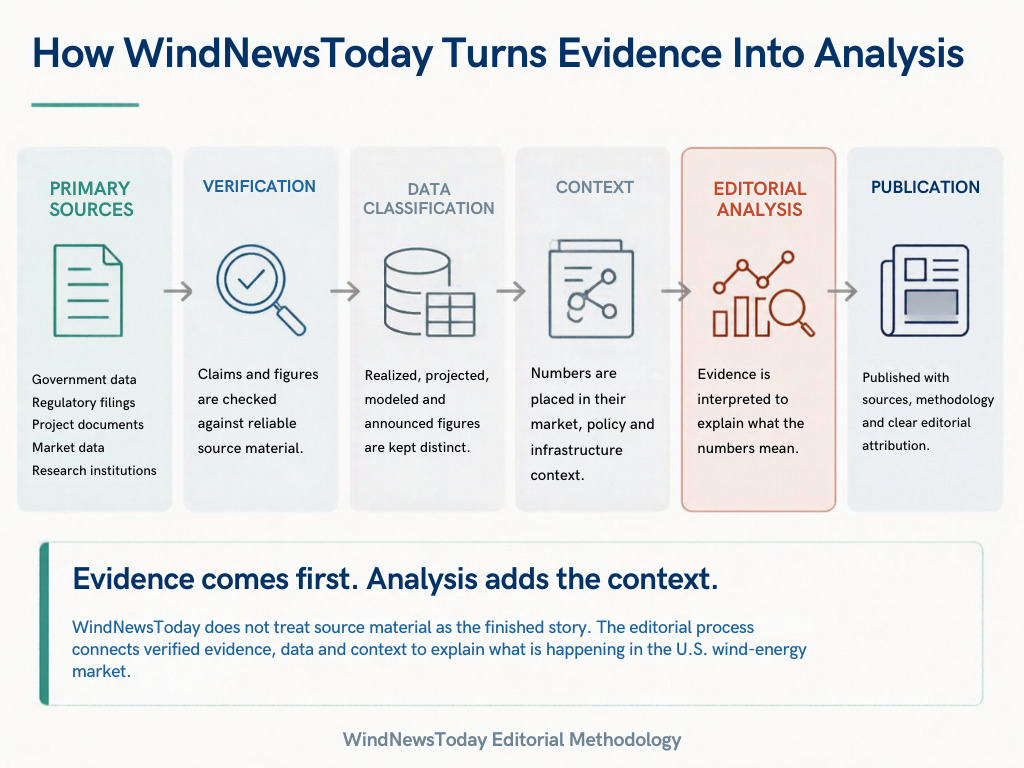
1. We Start With Primary Sources
Whenever practical, WindNewsToday begins with the source closest to the underlying decision, project, dataset or regulatory action.
For U.S. energy research, that can include:
- U.S. Energy Information Administration (EIA)
- U.S. Department of Energy (DOE)
- Bureau of Ocean Energy Management (BOEM)
- Federal Energy Regulatory Commission (FERC)
- National Renewable Energy Laboratory (NREL)
- Lawrence Berkeley National Laboratory (LBNL)
- National Oceanic and Atmospheric Administration (NOAA)
- regional transmission organizations and independent system operators
- state utility commissions and energy agencies
- utility integrated resource plans
- regulatory filings
- project contracts and procurement documents
- developer and manufacturer disclosures
For example, DOE’s Offshore Wind Market Report tracks U.S. projects and the broader global offshore wind industry, while its methodology combines industry and government information to assess project and market developments.
FERC’s generator-interconnection materials are used when the research involves the regulatory framework governing how generating facilities connect to the transmission system.
LBNL’s Queued Up research is particularly useful when analyzing U.S. interconnection queues because its dataset covers projects seeking transmission interconnection and provides project-level and aggregate queue information.
Source hierarchy matters. A news article describing a regulatory decision is useful context, but the underlying order, filing, contract or government dataset is generally stronger evidence for the specific factual claim.
2. We Separate Facts From Projections
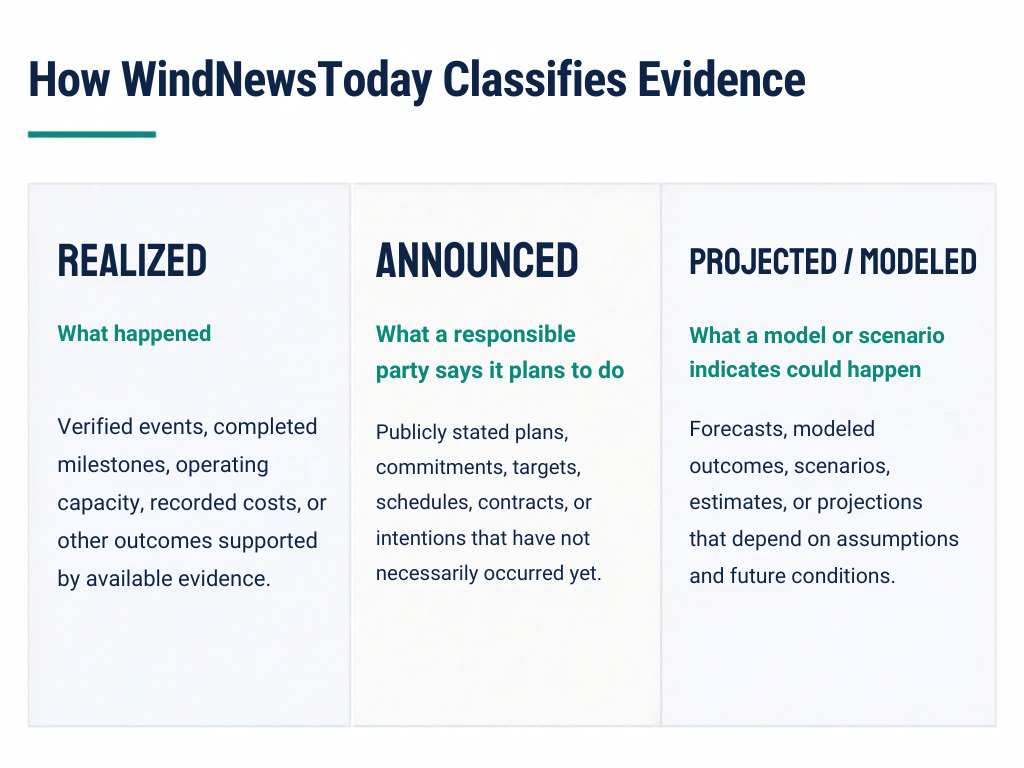
One of the most important distinctions in energy reporting is whether something has happened or is expected to happen.
WindNewsToday therefore distinguishes among different evidence states.
Realized
A development has occurred or can be verified as operating.
Examples include:
- a turbine producing electricity
- a project reaching commercial operation
- a transmission line entering service
- a documented investment already made
- an officially recorded electricity-generation figure
Announced
A developer, government agency, utility or other responsible party has publicly stated an intention or plan.
Examples include:
- announced project capacity
- planned manufacturing investment
- proposed construction schedule
- announced procurement target
An announcement is not treated as equivalent to completed capacity.
Projected / Modeled
The figure comes from a forecast, scenario, model or planning exercise.
Examples include:
- electricity-demand projections
- modeled levelized cost estimates
- future capacity scenarios
- long-term energy-system projections
These figures are presented with their appropriate source and assumptions.
This distinction is particularly important for AEO and other scenario-based energy research. EIA’s Annual Energy Outlook presents alternative cases and explicitly distinguishes modeled outcomes from a single certain future.
Under development
Where appropriate, we may also identify the development stage of a project separately, such as:
lease → site assessment → permitting → procurement → construction → first power → commercial operation
The exact terminology varies by project and source, so we preserve the relevant source definitions rather than forcing every project into an identical classification.
3. We Check What a Number Actually Measures
Energy reporting contains many numbers that look comparable but are not.
A cost figure, for example, could represent:
- capital expenditure
- equipment cost
- construction contract value
- total development cost
- financing-inclusive cost
- levelized cost of energy
These measures answer different questions.
The same principle applies to capacity.
A project may have:
- announced capacity
- permitted capacity
- contracted capacity
- nameplate capacity
- operating capacity
WindNewsToday avoids combining these measures as though they were interchangeable.
When a source uses a specific definition, we try to preserve that definition in the article rather than silently converting it into a more convenient number.
This is particularly important when comparing offshore wind with other electricity technologies or comparing projects across different markets.
4. We Cross-Check Important Claims
A single source can establish a fact, but important claims often benefit from independent verification.
For significant numbers or claims, our research may compare:
Primary source → government/laboratory dataset → regulatory or market evidence → reputable industry source
The purpose is not to create an artificial requirement for multiple sources for every sentence.
Instead, cross-checking is used when definitions, dates or reported figures may differ.
For example, LBNL notes that interconnection-queue data provide an indicator of developer interest but that many proposed projects ultimately withdraw. Its research also documents differences in project completion times and queue outcomes.
That means a large queue number should not automatically be presented as equivalent to future operating capacity.
The same principle applies throughout our research:
A pipeline is not an operating fleet. A proposal is not a completed project. A projection is not an observation.
5. Project Research Looks Beyond the Announcement
When WindNewsToday analyzes an offshore wind project, we do not stop at the announced megawatt figure.
Depending on the project, we examine:
- project capacity
- turbine technology
- lease area
- project location
- development stage
- permitting status
- procurement arrangements
- power-purchase agreements
- offtake arrangements
- interconnection point
- transmission requirements
- construction vessels
- port infrastructure
- supply-chain availability
- financing conditions
- schedule changes
- cost changes
- ownership changes
- first-power and commercial-operation status
This matters because the headline capacity of a project tells only part of its development story.
DOE’s offshore wind market reporting, for example, tracks projects across different development stages rather than treating every announced project as operating capacity.
For project-specific analysis, we therefore try to answer a more useful question:
Where is this project actually in the development process?
6. Market and Cost Analysis Uses Comparable Measures
WindNewsToday treats energy economics as a measurement problem as well as a reporting problem.
Before comparing two cost figures, we ask:
- Are they measuring the same thing?
- Are they expressed in the same currency and year?
- Are they nominal or real?
- Do they include financing?
- Do they represent a project cost or electricity-generation cost?
- Are they an estimate, a contract value or an observed result?
- What assumptions drive the estimate?
This prevents a common analytical error: putting different accounting measures into the same comparison simply because they are all expressed in dollars per megawatt-hour or dollars.
Where a direct comparison is not appropriate, we say so.
Our market analysis also considers broader factors such as:
- interest rates
- inflation
- commodity prices
- turbine and component costs
- supply-chain constraints
- electricity demand
- procurement conditions
- capacity markets
- transmission costs
- financing structures
The goal is not to produce a single simplistic “cheap versus expensive” conclusion. It is to explain what is driving the economics.
7. Policy Research Follows the Actual Decision
Energy policy can change through legislation, regulation, agency action, state decisions, procurement rules and permitting decisions.
WindNewsToday therefore distinguishes between:
proposed policy → enacted policy → implemented policy → policy effect
A proposal is not treated as law.
A policy announcement is not automatically treated as an economic outcome.
Where possible, we examine the underlying:
- legislation
- agency rule
- regulatory order
- lease announcement
- procurement decision
- state commission filing
- permitting decision
- official implementation guidance
This approach is particularly important in offshore wind because project economics can be affected by federal and state policy simultaneously.
Our Policy coverage provides deeper editorial
8. Grid and Interconnection Are Treated as Part of the Project
Generation capacity does not automatically become deliverable electricity.
For grid-related research, we examine the connection between:
generation → interconnection → transmission → substation → distribution → customer
depending on the subject being analyzed.
This can include:
- interconnection queues
- transmission upgrades
- congestion
- substations
- offshore transmission
- RTO/ISO planning
- capacity markets
- resource adequacy
- reliability
- storage
- demand response
- electricity-demand growth
FERC’s interconnection framework and nd LBNL’s national queue research provide important primary and analytical references for this work.
Our Infrastructure and Grid & Electricity Demand coverage examines these issues in greater depth.
9. We Treat Electricity Demand as a System Variable
Demand is not simply a background statistic.
Changes in electricity consumption can affect:
- generation requirements
- transmission planning
- capacity procurement
- resource adequacy
- utility investment
- power prices
- data-center development
- industrial development
- electrification
- renewable integration
When using demand projections, we identify the source, projection period, and relevant scenario.
EIA provides historical electricity data through its electricity-data resources and publishes long-term projections through the Annual Energy Outlook.
This distinction is important because a projected increase in electricity demand does not automatically mean that every planned generation project will be needed, nor that every project will reach operation.
The relationship between demand, generation, and grid capacity is analyzed as a system.
10. Dates Are Verified and Updated
Energy projects can remain associated with old dates long after their schedules have changed.
For significant project timelines, we therefore look for the most recent authoritative evidence available at the time of publication.
Where useful, an article may distinguish:
- original target date
- revised target date
- current expected date
- actual completion date
This is especially important when a project has experienced:
- permitting delays
- financing changes
- supply-chain disruption
- construction delays
- contract renegotiation
- turbine availability issues
- transmission delays
A historical date can still be useful, but it should not be presented as the current schedule.
11. We Explain Conflicting Numbers Instead of Hiding Them
Different sources can legitimately report different figures.
Reasons can include:
- different measurement dates
- revised datasets
- different project-status definitions
- different capacity definitions
- different inflation assumptions
- financing included or excluded
- different geographic boundaries
- different scenario assumptions
When the difference matters, WindNewsToday explains it.
For example, NREL’s offshore wind market-report methodology notes that project data can differ among sources because definitions such as “installed,” “operational,” “first power,” and commercial operation are not always used identically.
That is not necessarily a contradiction.
It can be a definition problem.
Our objective is therefore not to make every source produce the same number. It is to make clear why the numbers differ and which number is appropriate for the question being answered.
12. Visuals Follow the Evidence
Charts, maps and infographics are treated as part of the reporting rather than decoration.
Where a visual is used, we aim to identify:
- source
- measurement period
- units
- historical versus projected data
- relevant assumptions
- definitions where necessary
Examples of WindNewsToday visuals may include:
Project lifecycle
Lease → Development → Permitting → Construction → First Power → Commercial Operation
Electricity system
Generation → Interconnection → Transmission → Substation → Distribution → Customer
Market analysis
Costs → Financing → Procurement → Revenue/Offtake → Project viability
Demand analysis
Historical demand → Recent growth → Projected demand → Generation requirement → Grid investment
When we recreate a chart from public data, the underlying dataset—not the appearance of another publication’s graphic—is the basis for the visualization.
13. AI-Assisted Research Does Not Replace Editorial Judgment
WindNewsToday may use AI-assisted tools during parts of research organization, document review, drafting or information synthesis.
That does not make the resulting material automatically publishable.
Before publication, the work is subject to human editorial review.
That includes:
- checking factual claims
- reviewing source quality
- checking dates
- checking numerical definitions
- identifying unsupported assertions
- comparing conflicting evidence
- removing unnecessary repetition
- improving context
- reviewing the structure and argument
- determining whether a development is genuinely newsworthy or analytically significant
AI-generated material is therefore not treated as a primary source.
The underlying government document, regulatory filing, dataset, company disclosure, research paper or other authoritative source remains the evidence.
The final editorial judgment remains human-controlled.
14. How We Decide What Deserves Analysis
Not every announcement warrants a WindNewsToday article.
We generally look for developments that have implications beyond the immediate headline.
A topic may receive coverage because it affects:
- U.S. offshore wind deployment
- electricity markets
- project economics
- grid infrastructure
- transmission planning
- electricity demand
- energy policy
- domestic manufacturing
- supply chains
- technology development
- investment conditions
- energy-system reliability
We also consider whether sufficient reliable evidence exists to produce meaningful analysis.
This is an important editorial distinction.
WindNewsToday is not designed to reproduce every industry announcement.
The objective is to explain what a development changes, what remains uncertain, and how it fits into the larger energy system.
15. Our Editorial Standard
The methodology ultimately supports a simple editorial standard:
Be precise about what is known.
Be explicit about what is projected.
Do not confuse announced capacity with operating capacity.
Do not compare incompatible cost measures.
Do not treat a single headline as the whole story.
Show readers the evidence behind important claims.
Explain uncertainty when the evidence is uncertain.
This approach is especially important in an industry where project schedules, costs, policies and market conditions can change rapidly.
Sources and Research Resources
WindNewsToday’s research draws heavily on primary and institutional sources, including:
- U.S. Energy Information Administration (EIA)
- U.S. Department of Energy (DOE)
- Bureau of Ocean Energy Management (BOEM)
- Federal Energy Regulatory Commission (FERC)
- National Renewable Energy Laboratory (NREL)
- Lawrence Berkeley National Laboratory (LBNL)
- National Oceanic and Atmospheric Administration (NOAA)
- International Energy Agency (IEA)
- Global Wind Energy Council (GWEC)
These resources are not treated as interchangeable. Each source is used according to the type of evidence it provides.
For example, EIA is particularly important for U.S. energy statistics and projections; FERC for federal electricity regulation; LBNL for interconnection-queue research; and DOE/NREL for wind-industry technology, market and project research.
Editorial Oversight
WindNewsToday operates under human editorial oversight.
Ismot Jerin
Editor-in-Chief
Editorial responsibilities include:
- research direction
- source evaluation
- factual review
- analytical framing
- structural editing
- publication approval
For more information about the publication and its editorial standards, see our About WindNewsToday and Editorial Policy pages.
A Methodology Built for Energy Analysis
WindNewsToday covers an industry where the most important developments rarely fit into a single headline.
A turbine is part of a project.
A project is part of a transmission system.
A transmission system is part of a regional electricity market.
And all of those systems operate within a changing policy, financial and demand environment.
Our methodology is designed to follow those connections.
The goal is not simply to report what was announced.
It is to establish what happened, identify what is changing, show what the evidence supports, and explain why the development matters to the U.S. energy system.